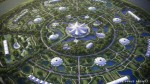
A Resource-Based Economy Is A Basis For the Future We See In The Star Trek Franchise.
Imagine a centralized, post-scarcity, resource-based economy where money is a dead currency; the one common factor in every hardship felt by Earth’s citizens.
It’s not science fiction, it’s science fact, and we could easily implement it today if we could educate the general public on the benefits of “The Star Trek Economy.”
“Our society cannot be maintained by this type of incompetency.”
~Jacue Fresco, The Venus Project
“The economics of the future are somewhat different, you see, money doesn’t exist in the 24th century. The acquisition of wealth is no longer the driving force in our lives.”
This quote from Captain Picard in “Star Trek: First Contact” hit many of us in a profound way, some of us were already aware of the possibilities of a planet free from the horrors of capitalism, while others were experiencing an epiphany of sorts.

A resource-based economy would utilize existing resources from the land and sea, physical equipment, industrial plants, etc. to enhance the lives of the total population. In an economy based on resources rather than money, we could easily produce all of the necessities of life and provide a high standard of living for all.
With RBE, every single heartbeat on the planet could live as the wealthy do today, no matter their station, minority, or geographical location.
The very existence of money is the catalyst for nearly every problem we face, including much you might not consider at first, but a shallow dive into the facts will inevitably lead you to the truth.
Racism, xenophobia, homophobia and transphobia, bigotry, misogyny, much of this would either wain dramatically or completely disappear from society as a whole as they they are merely distractions from the ridiculously powerful in order to keep us focused on fighting each other, in an effort to allow them to continue raping the planet and the inhabitants of its natural resources, time, and life’s blood.
The age old “Left versus Right” battle is a fallacy, an orchestrated facade meant to oppress, placate, and lull us into complacency. In Star Trek, these problems seem “light years away,” and rightfully so.
“Captain Jean-Luc Picard: This is the 24th century. Material needs no longer exist.
Ralph Offenhouse: Then what’s the challenge?
Captain Jean-Luc Picard: The challenge, Mr. Offenhouse, is to improve yourself. To enrich yourself. Enjoy it.”
~Star Trek: The Next Generation, The Neutral Zone
In a resource-based economy, all of the world’s resources are held as the common heritage of all of Earth’s people, thus eventually outgrowing the need for the artificial boundaries that separate people. This is the unifying imperative.
Many people believe that there is too much technology in the world today, and that technology is the major cause of our environmental pollution. This is not the case; the problems stem directly from unchecked capitalism and the lobbied corporation’s abilities to grow beyond what the planet can withstand.
“Work in the Federation is not a matter of compulsion or survival. Federation citizens need not perform tasks or exercise professions that do not suit their inclinations just so that they can afford to put food on the table and enjoy the respect of their peers. … What makes the Federation so appealing … It is the nature and meaning of work. It is almost a paradox to state it this way, but in a society where nothing is scarce and consequently where work is no longer a prerequisite for survival, finding good reasons to work becomes paramount, the defining existential question that everyone has to ask themselves. Why work at all if it’s not necessary? Because learning, making, and sharing is what makes life in the Federation worth living. Work, no longer a necessary burden, is the glue that holds the Federation together. It is the social bond and the social contract that impart substance and significance to life.”
― Manu Saadia, Trekonomics: The Economics of Star Trek
In closing, hold hope in your heart that a better, more inclusive and empathetic future is possible. With a resource-based economy, a Star Trek economy, our evolution is assured… and we will take our place among the stars.


 Watch: James Cooper’s ‘Interview With a Time Traveler’ Sci-Fi Short by Alex Billington September 4, 2014 Source: Vimeo “Why must everything that is broken be fixed?” This might just be a must watch, but I don’t want to get too excited.

 The Toronto-based writer has been self-publishing since 2011, and has received personal endorsements from Mark Millar (Kick-Ass, Wanted) as well as Stan Lee Comikaze CEO and Founder, Regina Carpinelli. Blake is also a regular contributor to






 nyrhalahotep